More Historical Context (with thanks to our guides and Wikipedia)
As I visited the various sites in Tokyo, but more so when we visited Kyoto and Osaka, it became clear that understanding each city is greatly improved when you have even a basic understanding of Japanese history. Certain aspects were repeated to us several times during our visit, not always consistently, but enough for us to realise its importance.
Tokyo, for example, only became the capital of Japan in 1868. That is a few years before Kingston became the capital of Jamaica. Japan’s deep cultural history was well established for centuries before then. The dominant period during which the country’s cultural core was shaped was the period of the Samurais which began in the 12th century and ended with the Meiji Restoration in 1868.
During the Samurai period, the capital, or seat of the Emperor, was Kyoto. The country was initially largely divided, with lengthy civil wars between different tribes battling for control. These ended when Tokugawa, the dominant Shogun, effectively the political leader, united the nation for a period of peace which lasted 250 years to the end of the Samurai period. The Shogun during that period was based in Edu (now Tokyo) and although powerful, did not command the same level of respect and devotion as the Emperor. During the Edu Shogunate (as it is called) Japan was closed to the world. That was the period when much of what is now recognised as the main tenets of Japanese culture were inculcated and solidified.
It is said that the beginning of the end came in 1853 when the American Pacific Navy Fleet turned up in Japan and sought (demanded?) trading rights with Japan. This led to disputes among the ruling classes as to the merits of opening the country up for trade with the rest of the world. That view prevailed and in true Samurai tradition the Shogun stepped aside and handed over power to the Emperor who moved the capital from Kyoto to Tokyo. The Emperor then launched the developments which form the basis of modern Japan, based largely on the adoption and adaptation of western technology. Some of it is readily apparent. For example, the railway system was adopted from Britain such that the Tokyo subway system is clearly a close replica of the London Underground.
Now on to Kyoto
With the benefit of the knowledge of this history, much of what we experienced later, especially in Kyoto, was much more easily understood. That however was not at the top of our minds when we started to make our preparations for the journey westward.
We were looking forward to or first ride on the Shinkansen. On the morning of Monday 13 November, our taxi arrived at the Tokyo station early enough to ensure we would have time to navigate any issues created by our lack of knowledge of the station. Turns out, like so much else in Japan, everything was very easily understood. Signs were posted in both Japanese and English and they were logical and simple. Sooner than we expected, we were in the (slightly crowded) waiting room to catch our train. Sadly, there was no specific waiting room for First Class (I checked), not surprising in relatively egalitarian Japan.
The Shinkansen lived up to expectations. Although traveling at speeds of over 300 km per hour, the feel is no different to being in an airplane at cruising altitude. The majority of the journey went through built up, mainly industrial areas, so perhaps not very scenic. It also did not make for good photos as everything whizzed by so quickly.
We arrived Kyoto on time, almost to the second. Not burdened by large heavy luggage, we thought it would be simple enough to take a taxi to our hotel – The Thousand, Kyoto.
The first taxi driver we approached barked, “No English”, when we attempted to tell him our destination. We assumed that a taxi driver from the Kyoto Station would at least have heard the name of the hotel before (it has no equivalent in Japanese characters). The communication gap was however easily bridged by Lolo whipping out her phone, finding the location on Google Maps and handing it to the driver who entered the details into his own phone.
So, off we went. The driver duly drove down to the first traffic lights, turned right, turned right again and drove into the entry foyer of a hotel. Alas. The Thousand, Kyoto. Total duration of journey – a full 120 seconds. The hotel is literally across the street from the station, on the side opposite to where we exited and entered the taxi.
We were initially perturbed by the taxi driver’s initial abruptness, but I concluded he genuinely did not understand us, reinforced by the fact that the hotel was apparently so new (completed during Covid, we were told) that most taxi drivers in fact were unaware of its existence. In most other countries however, once a taxi driver realises the destination is a short walking distance away, we would have been marched out of the car, with even the crudest sign language, to avoid losing the space in the taxi rank. I guess though in Japan a fare is a fare and the taxi driver honoring his code could not refuse it.
The Thousand was one of the hotels recommended to us, rather than chosen by us, and we may have paid less attention to the details as we otherwise might have. The design is super contemporary, giving the impression that some architects and interior designers were simply given artistic licence, with little regard for workable form and function.
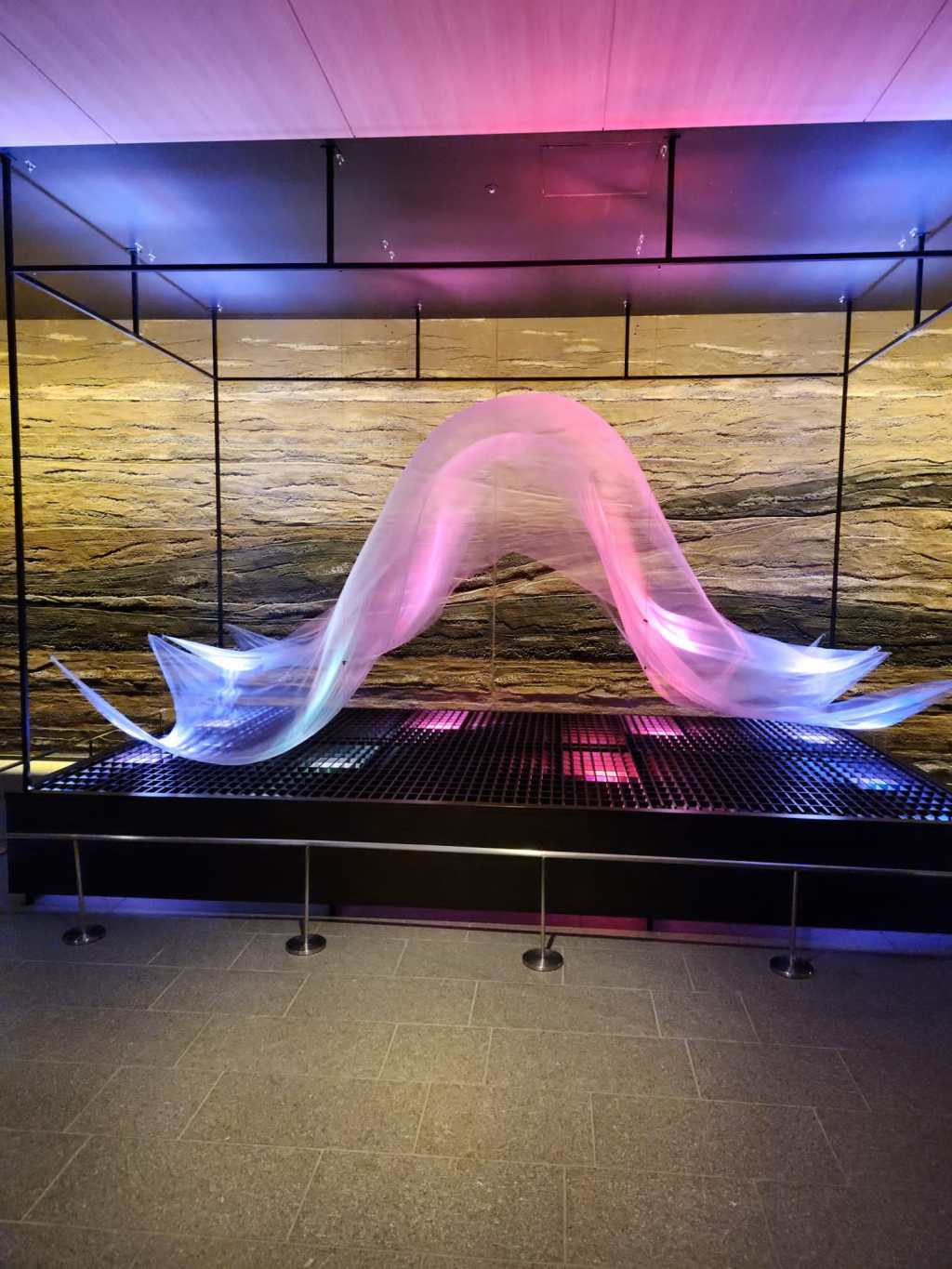
The lobby area was bathed in effervescent scents, which clearly pleased my spa owner wife. There was an interesting design feature in which an amoeba-like, formless thing floated in mid-air within an enclosure. The space though was dark and foreboding, with no natural light. There was no real lounge area to meet guests – only some oddly shaped backless benches, arbitrarily located.
It was about 12:45pm when we arrived and our room was not ready. We decided to have lunch. Of the three restaurants at the property, one was closed and one refused to accommodate us because we had no reservation. We therefore ate at the third, an Italian. I cannot say there was anything particularly memorable about the restaurant or the food.
When we eventually checked into our room, we were actually pleased. We noted that they had Kimono style pajamas, just like the New Otani, but nicer, more stylish. Almost everything was automated – the lights, the drapes, even the toilet. The room was also very nicely appointed. We had a little patio with a garden, even though we were on the 5th floor. It however opened up to the station so, with the attendant noise, and the fact that the temperature was quite chilly throughout our stay, we did not use it much.
That afternoon we did not do much. We had tours planned for Tuesday and Friday, and expected those days, at least, to be vigorous. We did discover the hotel had a very nice gym, which I planned to use, following my personal commitment at the beginning of the trip.
Delightful Tomo
Following our arduous full day tours the prior week, our 4-hour tour of Kyoto on Tuesday the 14th was welcomed. We met our guide, Tomo, at 9:45am as agreed, in the hotel lobby. When I saw the person holding my name I literally stepped back with a little startle.
First, our guide was not over 65 years old. Nor a man. Tomo (I did not guess by the name) was an extremely pleasant lady, perhaps in her early 40s. She had been a guide for over 10 years and spoke fluent articulate English to the point of using and understanding those nuanced statements used in advanced English. As a professional guide she obviously had significant experience dealing with foreigners, so we related very well throughout the day.
She led us across the road to the Kyoto Station. That was when it really dawned on us how close we really were to the station. Out first stop was the Nijo Castle. This used to be, effectively, the Shogun’s city villa in the capital. We were able to tour the interior, shoes off of course, but absolutely no photos. There were various rooms depicting the order of hierarchy which included life size images of the Shogun and his attendants. There were rooms where he received captured foes and rooms where he entertained friendly guests, each in layout and design reflecting the differing scenarios. The only room where the Shogun’s place was not one depicting complete superiority was the room in which he received the Emperor’s messenger.
There were vendors outside the castle. Each, Tomo told us, had been specifically selected. We were persuaded to purchase a special bottle of sake, in part because Tomo insisted that, since Kyoto had the best water, it also produced the best sake, but also because of the brilliant salesmanship of the vendor.
Back on the subway we traveled to the Fushini Inari Shrine. We quickly learnt the difference between a shrine (Shinto) and a temple (Buddhist). The majority of Japanese are Shinto, which is the indigenous Japanese religion. The next largest is Bhuddism, imported from India. A significant number of Japanese are both, an indication that although they earnestly follow the traditions the Japanese are not devout people. One guide described shrines, temples and churches (only 1% of Japanese are Christians) as a place the Japanese go for special events.
The Fushini Inari Shrine is one of the most significant. Kyoto was of course a great power centre for the Samurai. And the Samurais were Shinto. The importance was marked by the large crowds of visitors (patrons), mostly Japanese, many girls dressed in rented kimonos and men in Samurai outfits.
As Tomo explained the rituals, they were played out before our eyes as people came up to the various altars and threw in some coins, bowed their heads, clapped their hands in the slow methodical manner also practised by the Shona in Zimbabwe, and made a silent wish. Beyond that, the atmosphere was relatively festive with much of the focus on capturing the most Insta-ready shot.
We were able to walk from the Fushini Inari Shrine to the restaurant where Tomo had made a reservation for lunch. As we found throughout our visit, especially in the areas close to the main attractions, it was never quite easy to get restaurant reservations. Despite the large crowds, the restaurants are usually relatively small, many having only a few seats. As such, we were lucky to have had these super-attentive guides with the foresight to make advance reservations on our behalf.
This was when I had my first taste of whale meat (sorry Sea Shepherds) which was rather tasty.
On the way to lunch Tomo had pointed out the location of the Ginza District, the home of the origin of geishas and the whole geisha tradition in Japan. She also pointed out an area where we could find several restaurants and bars if we decided to have an evening out. Afterwards, she took the mandatory selfie with us which was posted on TripAdvisor by that evening. Lolo and I were only too willing to provide a generously complimentary review.
After lunch, Lolo and I decided to walk to the Ginza District. We had a scheduled Dinner with Geishas planned for the following evening, and although we did not wish to ruin it, we thought we would do an easy unguided walkthrough.
Dinner with the Maikos
We found the main street within the Ginza District with no difficulty. Although we did not know precisely what to expect, we did note that the place was flooded with tourists. There were signs which said, “No photographs on private streets”, but it was difficult to identify what specific areas fell within the prohibition. Needless to say, with no one seen trying to enforce it, it did not prevent a virtual feeding frenzy whenever anyone spotted a girl they think is a geisha. We saw one appear into the street, actually a maiko, or geisha in training, and a middle-aged female tourist was literally running behind her trying to take a close-up video. Poor girl was hastening as fast as allowed by her socked feet in geisha slippers, and the grace required by her training. It was like predator hunting prey. We would by the following evening find out the whole history and significance of the geisha tradition to the Japanese. The foreign fascination I understand is mainly from the movie Memories of a Geisha, which I am yet to watch.
After we completed our Ginza District walkthrough we checked our GPS and saw that it was a 35-minute walk back to our hotel. We decided to go for it. It was a bit cold and we kept buying and adding stuff to my backpack, which was getting increasingly heavier. It was nevertheless a pleasant walk, first across the bridge, and then along the side of the Kamo River – a route we would take again more than once over the coming days.
With nothing planned before evening on Wednesday we decided to scout the surroundings, first to find a nice place for a late breakfast/early lunch, and then to see what lay beyond our hotel. We were somewhat disappointed with what we found. Kyoto seems to have had its best days back when the Samurais ruled. There are still many buildings which are obviously from that era, with their elaborate roof structure and relatively complex but artistic designs. Others, built more recently, were built to capture that essence. We are told there is a strict height restriction, so no really tall buildings, the tallest it appeared to us being the Kyoto Station, which we later discovered to be at the heart of the city centre. We struggled to find an attractive restaurant but could not help noticing the oversized Starbucks and Burger King positioned prominently across the road from the station.
We eventually chose somewhere, in part because we did not wish to keep walking around hungry all day.
I cannot recall precisely what we were looking for when we ended up on the third floor above Starbucks and walked into the Japan Tourism Agency’s information office. There were displayed in the office a number of brochures for Kyoto activities and attractions. Browsing through them we spotted one for the Kenbu Samurai Theater show and lesson. We thought that seemed an interesting activity so we duly joined the queue to purchase tickets. Our only free day that week would be Thursday, since we had a tour booked for Friday and were due to travel to Osaka on Saturday.
As it happened, the only available tickets were for the shows on Friday and Saturday. After a short consideration, we decided to purchase tickets for Saturday. The only problem was that the scheduled time was after we were scheduled to catch the Shinkansen to Osaka. We resolved quickly to try to change our train tickets, or if not possible, purchase new tickets.
That evening was our scheduled Dinner with the Geishas – for which we had paid handsomely online. We decided to take a taxi back to the Ginza area we had toured briefly on Monday. Although the Kyoto subway and trains seemed uncomplicated enough, we felt we did not want to risk arriving late if we failed to figure out the trains right away.
Yet again we took the bridge across the Kamo River. The taxi driver deposited us across the street from the specified meeting point. I was not quite sure why there as a “meeting point”. I thought we were simply going to the venue for the dinner. I also probably did not dwell too long on the details of the package, if in fact they were provided. I was quite thrilled to have found an event which I thought would match Lolo’s heightened expectations, she having previously attended a “proper” geisha tea ceremony, and was very keen that I had the experience.
At the meeting point, we were met by Mei, our guide. Mmm, I thought. At least we had an English speaker to explain and translate our experience. Mei then started to explain that we were in fact in for a full guided tour of the Ginza District, before we went to the “Tea House” where we would have dinner.
Uh oh, were we wearing sensible enough footwear for another walking tour? Luckily, on that score, my shoes would always be sensible enough for a slow walk along city streets. And as it turned out, Lolo had in fact packed no insensible (dress) shoes at all for the trip. Not that she had suddenly decided to ditch impractical shoes altogether. Turned out, they were somehow omitted on the third re-pack of her suitcase before we left Cayman. So her very comfortable soft shoes she had been wearing almost everywhere other than on the long day tours, proved a great choice.
Mei took us through some of the same streets we saw on our previous unguided walk. She also took us to and through a number of streets we thought forbidden, since we had seen no one on them. She gave us the full official history and explanation of the geishas – apparently pronounced “gaiko” in Kyoto, the place of the culture’s origin, and maikos – the geishas in training.
Speaking with unrestrained deference and awe she refers to them as “Gaiko San” and “Maiko San“. She explained that the tradition evolved out of the development of tea houses in the Ginza District to provide refreshment and a place of respite for visitors to the nearby Fushini-Inari Shrine, before they commenced the sometimes long journey back home elsewhere in Japan. Tea of course was to be accompanied by cake, and ultimately by entertainment.
The training to become a geisha is in fact a period of apprenticeship which lasts four years. During this period the maikos are completely immersed in an intensive training which lasts all day and covers study, music (they all play an instrument), conversation and a strict dress code which addresses everything from the hair to the shoes. They pretty much belong to the tea houses and are forbidden to marry unless they ever retire from the geisha life. Their outfit is amazingly expensive (up to US$10,000 we were told), each with the distinguishing belt and emblem at the front, capable of costing hundreds of thousands of US Dollars.
We enquired about the “No photographs” policy. Whereas we thought it was born out of some sacred nature of Gaiko San and Maiko San, we were told it was really introduced in order to protect them from the hounding of middle-aged tourist women. High paying customers were of course afforded the privilege, so we were let into their inner sanctum.
We then got to observe the practices up close through a sumptuous 7-course meal in the presence of, as it turned out, two maikos, not geishas. As we found out, only the most privileged (and wealthiest) have the option of dining with real geishas. Poor us!
Both maikos were around 19 years old and were in their final year before graduation to be a full geisha. We were allowed to ask questions, which Lolo took full advantage of. You could see that they were very well drilled and committed, but in the end, they were in many ways like most 19 year old girls. Their greatest moment of excitement was seeing Lolo’s Samsung Z-Fold Smartphone.
They were overall quite fun and laughed and giggled and were good at their instrument and in the little choreographed dance they did. They even played a couple of games with us which could be great drinking games. If you understand the Japanese, you will understand how they would find enjoyment merely by engaging in a bit of frivolity (I am sure someone will point out this over generalisation). I, however, tend to drift off if the conversation or entertainment is not particularly engaging.
Anyway, it was great to share in this revered Japanese tradition, even if we were only offered “Geisha Lite”.
Arashiyama Bamboo Forest and Monkey Park
The following day, Thursday 16 November, we went on a tour of the Arashiyama Bamboo Forest and Monkey Park. Our guide was Ichiro – back to the remarkably robust over-65 tour guides. We met at the Thousand Kyoto lobby and from there walked to the train station. The bamboo forest was lovely. The weather was good and it was great to see the towering plants in such number in their full majesty.
Being familiar with bamboo in Jamaica, and lots of wild bamboo as well, I had only chosen that tour because it was one of the most recommended in Kyoto, and the fact that it would provide a great opportunity for a nice hike in very pleasant natural surroundings. What was most remarkable however was that there seemed to have been more people than bamboo. The paths were packed, cheek to jowl, such that walking was slowed to a crawl in most places. Yes, the bamboo forest was nice, but it was ruined as a spectacle due to the massive crowds. I did not really get it.
The walk to the Monkey Park was up a fairly steep incline. Now, here was the workout we were hoping for. Ichiro kept up the pace, no doubt hoping we could keep up, which we did, and for which we won his praise at the end for being “vigorous walkers”.
The “monkeys” were less remarkable. Ichiro did not resist when the Zimbabwean pointed out that these were really baboons. The creatures were relatively unfazed by the human encroachment into their habitat – including those people who thought it was somehow fun to be caged so the monkeys could get a close-up view of them. Luckily the crowds were much less, no doubt due to the steep hike required to make it to the area.
Lunch that day was one of the more memorable. We took a little while to find a restaurant with availability. Each, surprisingly, had very limited seating given the number of tourists in the area. When we eventually did, with no little amount of persuasion, we got Ichiro to join us. We perhaps only succeeded because we told him we needed his assistance in understanding the meals. Even so, he asked about five times for confirmation that he could order the meal he had chosen.
This was to be my first encounter in Japan with the famed Kobe beef. By the way, in case you wondered, Kobe is the name of a place, not far from Kyoto, and the stories regarding the extra care to the cattle are true (mostly).
I chose a meal whose name was the Kobe Beef Shabu Shabu. Ichiro explained that the term “shabu shabu” describes the process used. It was insanely expensive – by Japanese standards.
The first thing that showed up were multiple strips of raw meat – cut in slices as thin as bacon slices. I was puzzled but unfazed. I know the Japanese love sushi and other forms of raw fish, of which I had a fair bit by then – so what if I added raw beef to my list of conquests.
Then appeared a small stove and a pot with water. This was followed by a selection of vegetables, and various sauces and, I presumed, condiments.
Then followed Ichiro’s explanation. I was to turn on the stove, bring the water to a boil, at which time I should pick up the meat and wave it around in the hot water. Apparently I was also to say, “Shabu, Shabu” whilst I did it.
Imagine, I am doing this with chopsticks the expertise in which I have grasped just about as well as I have managed to master golf. Having waved each piece until I was sure it was cooked, I proceeded to eat. Somehow, I did not quite feel a burst of flavour. It was just like, well, I was eating freshly boiled raw meat. I then put the vegetables in, stirred a bit and had the mixture as soup.
Not sure if it was that Ichiro did not explain it well, or I was confused within the language barrier, but it seems I should have first made the soup, then do my shabu shabu, at which point the meat would have acquired some flavour. I may also have ruined it by my ignorance as to how long I should keep it in the boiling water.
Don’t blame me though. I am accustomed to going to a restaurant and, having placed my order, being presented with a meal ready to eat. Instead, I was given a bunch of ingredients, a pot and a stove and one go to get it right. Quite an experience that was.
After lunch we toured a famed Buddhist temple in the area. There was quite a history to it, the most intriguing of which was that it contained the entire “Library of knowledge“. For a fee you could push the library which is set up like a wheel. If you do so you will have gained all the knowledge in the library. Pushing the wheel was fun. Not sure though how much more knowledgeable I became as a result.
That evening we made a most remarkable discovery about Kyoto. We had been wondering where on earth were the shopping plazas and the restaurants, cafes, etc. After Ichiro took us back to Kyoto Station, we started to look for a place to eat. We spotted a place a couple floors above and took the escalator towards it. We missed the floor and kept going from floor to floor upward. The station is seven or eight storeys high. Not being satisfied with the places we had seen, we took a sky walk across to the other side. It seems there was everything within this station and it was designed such that it seemed like the main centre of activity in the city. Along the skywalk we passed a room with a grand piano and an obviously expert pianist playing to an audience of one sitting in the room, with the music floating out through the entire area.
As we took some time to discover over the next couple days, the station has everything, including a full-on shopping plaza underground with international and local brands, and a coffee shop – Ogawa Coffee – which sold Jamaican Blue Mountain Coffee. Not doubt it deserved more than the one visit we paid it.
Pobtocho Alley
We had nothing pre-booked during the day on Friday 17 November so did some more exploration of the shopping plaza within the Kyoto Station. We had decided that in the evening we would check out the area, Pobtocho Alley, which Tomo had pointed out as a good area for nice restaurants and bars in Kyoto.
We had no advance reservation, as nothing in particular stood out when we searched online. In the evening, we took a taxi, again across the bridge to the same area we had been on Monday for lunch, then took a left turn to the top of a pedestrian street. We hopped out and started the walk down. The area was packed with people going up and down – this clearly was the area to be in Kyoto. We initially did not identify an obvious restaurant. A surprising number of them were empty, which we did not find attractive. Plus, we like to explore as many options as possible before settling on a choice. If we see a potential candidate, we would “stick a pin” to return if nothing better turns up.
After walking a decent stretch of the street, with the never ending stream of people, we were surprised there were no restaurants with terraces (or windows) overlooking the streets, or some other alluring feature which allows people watching. I have to say I found that everywhere we went in Japan. They are not big on “al fresco” dining. Nor do they try to attract you by ambiance. Come for the food, or don’t come at all.
We turned around and retraced our steps to a Korean restaurant named Ponto-Cho Leenamha we had spotted on the way down. As was commonly the case, we were met in a small reception area and directed to the main seating upstairs, which cannot be seen from the streets. Up the stairs we were greeted by an expansive outlay, and with a view to boot – over the Kamo River.
I went for the fixed menu which had as its main dish a choice from three different waygu beef dishes. I went for the stoned plate grilled wagyu.
Now here was a massive explosion of flavour! I could not have enough, wiping off every plate as clean as I could with my chopsticks. Ponto-cho Leenamha describes itself as Korean but produced one of the best Japanese dishes I had in Japan.
Once we finished dinner we started looking for a nice bar or club to finish up the evening. Again, not easy. We walked along the alley and then crossed over to another street. There we started to see the clubs and bars. Each had a couple of people trying to entice you in.
As we came up to one of them we were greeted a very charming hostess who told us they had two floors, each offering different music. We decided to check it out. The first of the two floors was playing hip hop. The music being played by the DJ was all familiar. The crowd was small and looked the more edgy type, probably attracted by the fact that smoking was permitted. We hung around bopping for a while before going to check out upstairs.
The place was packed and wild. The DJs were playing house, new wave, techno, dance music. It was how I pictured a party in Tokyo. Everyone did the same dance move – jumping up and down with absolutely no control over their flailing limbs. Again, the DJs did not have to be creative – just play the same hits you have been hearing for the past 10 years – “Oh, Oh, sometimes, I get a good feeling …..” You know the mix. No one cared. The place was bouncing, and so would your drink – out of your hand, if you don’t hold a firm stance, as I did. We stuck around for quite a bit as the scene was quite fun. After a while we went back to the hip hop floor briefly, as the groove was calmer, before leaving.
We had to walk a fair distance back to the area of the bridge to catch a cab. On the way, we popped into an open 7-Eleven for Lolo, not one to eat much during dinner, to get something to curb her late night hunger pangs.
Samurai Pretenders
The next day, Saturday, was our scheduled departure to Osaka. We had originally booked a 12:15 trip for the 15 minute ride on the Shinkansen. We had however changed that to leave at 9:07pm, in order to allow us to go to the Kenbu Samurai Theatre class at 4:15pm. We decided to get to the theatre a little early so we could eat a very late lunch in the area. When we got there we noted that there were absolutely no restaurants or cafes in the area, except for a McDonalds a 10 minute walk down the street. So that was lunch. Lunch at McDonalds, as usual, was quite unremarkable, except for the fact that we had to place and collect our order on the ground floor then walk up to the 5th floor to eat.
The theatre was a bit nervy for me, as I tend to get whenever I am to do anything completely new. We had a bit of a show and history lesson before the group of us who signed up for the lesson got dressed up in our Samurai costumes.
Then into the lesson.
How to hold your sword. How to place your sword into the shield. How to chop from overhead. How to chop from the right. How to stab. Ride the horse into battle. Chop from overhead. Jump. Present your sword. Place your sword into the shield. We were allowed to pose for photos.
Then for the solo performances.
Who wants to go first? I was keen to get it out of the way, so I stuck my hand up. After all, I seemed to have been managing all the moves during practice. Not like that girl who always had the shield for her sword upside down, so it got stuck going in. Or the 10-year old boy who just did whatever the hell came to his mind.
The instructor said he would be going through the moves as well. I wasn’t sure what that meant, but in my usual way, I assumed this was a test of my memory and skill and it was not Samurai-like to cheat.
Oops! I messed up the very first move. I proudly walked out to the stage and placed my shielded sword into position. Clatter, Clatter, Clatter! My sword, not properly shielded since it was last removed, fell to the ground. The cameras were already rolling. I sheepishly blurted, to everyone’s amusement, “Take 2!” The instructor obliged and I started again from the top.
None of the routine felt right. I was probably still put off by having grounded my sword before the battle even started. In a real Samurai war that would have meant certain death. If I had not been killed by my enemy, I would have been honour bound to commit suicide after the battle.
The instructor was going through the moves as he stated he would, but as I was concentrating so hard to get it right, I was not watching him – eyes on the audience.
Relieved to come to the end of the routine, I proceeded to holster my sword. First attempt – stuck. Second attempt – stuck. I now had to look away from the audience. Oops! My holster was upside down. So I had to rotate it to the proper position and, presto, the sword went in. The whole thing was playing out in super slow mo, for me at least. I was so embarrassed for having messed up the routine so much.
I then watched the other performers. Each got increasingly better. The girl who always had her holster upside down in practice was last. She smartly started each move a few seconds after the instructor, whilst she watched. Her performance was flawless right up to the point of holstering her sword. Now let’s see how well she does this. Flawless.
I sat there thinking how much better I could have been, one, if I had not rushed to go first, and two, if I had the good sense to realise it was not really a test – just watch and follow the moves, as in practice.
I was supposed to record Lolo’s performance on video, and did, as it turned out, but for a while thought I had failed to do so. What a clutz!
Or so I thought at least, until I shared the video, which had my perfomance combined with Lolo’s performance. Everyone thought it was so funny, that is, deliberately funny. I relaxed after that.
 Sabbatical Odyssey
Leave a comment