Hello Tokyo
Arrival at Tokyo’s Haneda airport on Monday 6 November, airport pick-up, the drive to and check-in at the Hotel New Otani in Chioda City, were all smooth and painless. Our longest delay was to figure out that the “Hire Stand” is the same as the taxi stand, which was to be our reference point for locating our driver for the hotel transfer. At the New Otani, we managed to slip into the Satsuki restaurant for dinner before last call at about 9:45pm.
The following day, Tuesday the 7th, we decided to do what I regularly do whenever spending more than a couple of days at a hotel. We explored the hotel grounds and amenities, and tried to see what intelligence we could pick up about the city before our pre-planned excursions.
Well, let me just say that after 7 days at the New Otani, we still did not feel we discovered the entire place. First, a bit of history may create context. According to the information on display, the hotel was developed close to the Imperial Palace by Yonetario Otani, at the request of the Japanese government, in preparation for the 1966 Tokyo Olympics. It got a reboot in preparation for the 2020 Tokyo Olympics, ultimately held in 2021.
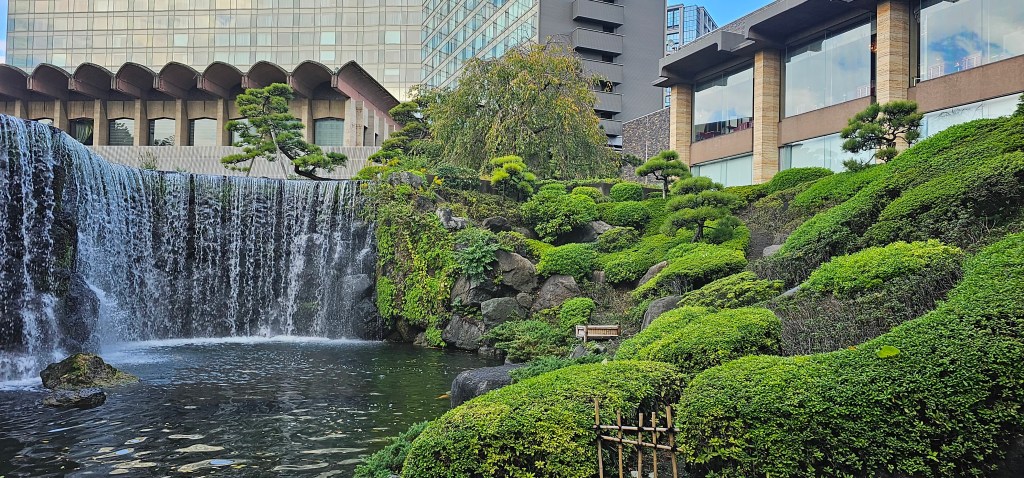
So you should not be surprised by its Olympian size and grandeur. The place is a destination in itself, not merely as a resort for foreign tourists, but also for the Japanese from Tokyo and beyond. To start, the property actually comprises three hotels – The Main (where we stayed), The Garden Tower and The Garden Court. Its gardens, complete with its spectacular waterfall, cute little red bridges, koi fish and lily ponds, hidden tea houses and every type of local flora, are the perfect backdrop for the multiple weddings hosted at the hotel.
The multiple shops within the hotel are more than the usual final refuge resort wear shops for those who failed to pack adequately. You find those, but there are also proper shops with things you (especially you ladies) would buy.
There are more restaurants than you can count, or visit – some distinctly Japanese, like the Garden Restaurant, overlooking the aforementioned gardens, the Satsuki (mentioned above which was breakfast restaurant), and Kato’s Dining and Bar (more on this later), and others with a distinct international flair, like the French themed Tour D’argent.
There is at least one entire floor dedicated to weddings, which seemed to happen every day. For crying out loud, the place even has a post office and a supermarket. Walking distance from the subway station also does not hurt.
Missing though is a nice lobby bar. You know, the type you wander into after an exhausting day. There is Trader’s Vic Bar, but it is hidden away with a view of the steepling wall of another building, and décor comprising scary stuff hanging from the ceiling. We got there in time for Happy Hour one evening but left once we satisfied our gnawing hunger following a long day out.
That day convinced us that our choice of Tokyo hotel was a good one – a fact confirmed by a number of people we met during the upcoming week. And the perfect base from which to explore the city.
Hero Hiro
Our exploits started the following day. We had pre-booked an 8-hour walking tour of Tokyo through the Japan Guide Agency (as we did with all our other pre-booked tours in Japan). Our guide was Hiro. We had no idea what to expect. Not wanting to be late for our appointed meeting time at 8:50am, I abandoned a trip to the ATM to get more cash (which we were warned was an essential), in order to get to reception at 8:45, only to see Hiro, casting around to see anyone who looks like they had lost a guide.
Not an issue which should necessarily concern us, but we did note that Hiro seemed to be past normal retirement age. He took us through a brief pre-tour outline for the day and then we set off.
Well, it was obvious from the get-go that Hiro did not feel we had enough time to get through the day’s itinerary. It was as if he was doing the 20km walk at the Olympics. He set off at a demanding pace which had us half jogging all day.
We headed into the nearby subway station where he quickly showed us the good sense in purchasing an all-day ticket (for 660 Yen each) – a practice we adopted for the rest of the week – even when a simple return ticket would do. Our tour took us through the Imperial Palace and East Garden, the Tsukiji Fish Market, the exclusive Sushi Mitomi restaurant in the Shibuya area, followed by a visit to the top of the Shibuya Sky Walk to take in a panoramic view of the city, a brief tour of the Nezu Museum and Gardens and finally to a lovely Korean tea house in a uniquely designed building – which was not our pre-planned schedule.
The day was not untypical of what we were to expect in Tokyo for the week. First, Hiro was not the untypical guide we would experience. He had been a guide for 5 years following his retirement from his long career. His knowledge of Japanese history and culture was excellent, but his English was just adequate – not fluent by any means. He gave detailed explanations of every site and of their significance.
His choice of the sushi restaurant for lunch, Sushi Shitomi, was an excellent one. You would think, this is Japan, so get ready for sushi and an abundance of raw fish. True. But this was no ordinary restaurant. This place was operated by a master chef and we got to watch him in performance. Each piece was individually prepared and presented with flourish. There was much extravagance in the presentation.
There was only one other couple at the restaurant (if it can properly be so called), an elderly couple who had travelled from outside the prefecture (the region within which Tokyo falls), to dine from the hands of the master. They were a delightful duo – bright and funny, which we discovered through Hiro’s translations and their few English words. Lolo whispered to me, “That will be us in a few decades.”
The cost of the lunch, which included a generous supply of sake, was the princely sum of 21,000 Yen (or approximately US$140), not much, when compared to what a similar experience would cost in Cayman. Except, when I produced my credit card, Hiro explained that cards were not accepted. I had not figured that this place, given Hiro’s description, would have fallen within the category of “small establishments” which only accept cash. Having previously reimbursed Hiro for the various entry tickets he had purchased in advance (and given my aborted trip to the ATM earlier) we were a bit short. We had to borrow back from Hiro what we previously paid him to make up the difference. That meant our next place of interest was the nearest ATM. We did note later in the day that the occasion proved a slight embarrassment – not for us as it happened (we were shameless), but for Hiro, who later asked whether he had taken us to a place which was too expensive. He took some persuasion.
Other significant notables for the rest of Japan. The public transport system is impeccable. The Tokyo subway is a virtual replica of the London Underground – red line, green line, blue line, etc. You select your destination, choose your line and where you change. The only times we took a taxi for the week in Tokyo were for the trip from the airport to the hotel and from the hotel to the train station when we left for Kyoto.
At the end of the day Hiro escorted us back to the hotel and gave us tips for the rest our trip – and requested us to leave a review on TripAdvisor. The following day, Thursday the 9th, we took up Hiro on one of his recommendations. We took the Ginza line on the subway up to Kappabashi Dougu Street, the main street where one purchases Japanese knives. The significance of this will in time be revealed to some but not all who read this.
That evening we dined at Tower Restaurant, another of the multiple restaurants at the New Otani. Tower occupies the entire 16th Floor. Every seat is a window seat and provides an expansive, unobstructed view of the city. The meal is buffet style, which often is not conducive to what most will regard as a memorable dining experience. Not so in this case. Apart from the fact that we did not come across many restaurants which seemed to emphasise the view or ambience, the outlay and choices were excellent. There as an array of chefs at a number of attended stations where you could get choice cuts. There was also an army of staff which attended to patrons with military style precision and efficiency.
This was common to most of the large restaurants we visited. Everyone is suited and wired for sound. You sometimes have an assigned server, but any member of staff will attend to you. In common with smaller and a la carte restaurants, as soon as your order is placed and delivered you are presented with the bill – often in Japanese. If you order more items, the bill is removed and replaced. In most instances you take the bill to the cashier at the end where you pay.
As soon as each order is prepared, it is delivered to the person who made it. The other(s) follow when ready. Don’t worry, go right ahead and start eating when you get served. The other orders usually follow shortly after.
Don’t try to leave a tip. It will be politely, if firmly, declined. The best response I heard was, “It is already included.”
Where is Mount Fuji?
Friday 10th November was a day we were anticipating, notwithstanding our hopes were already dampened on Wednesday when Hiro checked and told us that rain was predicted from around noon on Friday. This was a trip to the Mount Fiji area. We would visit the Mount Fiji Five Lakes, the Mount Fuji Panoramic Ropeway and the Oshink Hokkei area. We anticipated a lot of hiking. I was ready – clad in my North Face hiking boots and even had my trekking sticks in case we needed to navigate steep, uneven terrain. Sadly, Lolo had not brought her hiking shoes, which are still sitting in Zimbabwe, and her efforts to purchase substitutes in Tokyo were repeatedly met with the reality that her shoe size is a tad larger than the female sizes available in Japan.
Our guide Yoshii had also checked the weather report, and having done so, suggested an earlier start to beat the rain. We therefore met Yoshii at our hotel at 7:30am. Yoshii’s antecedents were quite similar to Hiro’s – a retired career professional who started guiding after his retirement. He too was a super-fit specimen – in fact extremely so. He had previously cycled through 70 countries consecutively.
Mount Fuji is a 2-hour train ride from the Shibuya station in Tokyo. That meant our day started with the half jog to the subway station from which we would travel to Shibuya. This was not the famed Shinkanzen or Bullet Train, but comfortable, nice and fast enough.
Turned out it started to rain even before we got to the Mount Fuji area. It was cold and cloudy all day. That meant we never set eyes on Mount Fuji, except in an excellent photo in a restaurant against which Lolo and I took a photo, our best evidence that we got anywhere close to the famed landmark.
The persistent rain meant that our hikes were curtailed, or in some instances abandoned. That did not however prevent us from getting some spectacular pics of the Autumn Fall, highlighted by fiery reds and yellows from the Japanese maple and ginko trees. Yoshii did seem a bit agitated that we were missing our schedule. At times, he was literally running to ensure we meet appointments. This was not helped by the long queues at the many small restaurants, none of which seemed to accommodate more than 10 people at a time. He also missed a couple of turns, which meant we made it just in time to board the last bus back to Tokyo – not being able to secure a return ticket on the train. Long day.
We had nothing planned for Saturday 11 November so we had a leisurely morning before we headed off to the Ometesando shopping area. We mainly people watched, especially at the phenomenal Shibuya Crossing. There are busy intersections in many great cities, but this is something. A combination of Japanese discipline to wait at the tracking lights until the “Walk” sign turns green, a confluence of subway stations in a major shopping area, and the novel idea (to me at least) of having pedestrian crossings run both diagonally as well at right angles, meant that when the lights finally change there was an absolute tsunami of people for just long enough until the lights changed back to red. At which time the flood comes to its predictable halt.
We had lunch in Ometesando that day. Nothing particularly remarkable about the restaurant, but we got to observe, after the predictable wait in the queue, an interesting holdover, apparently from Covid. The restaurant was particularly busy, as were most in that vicinity. Once you are sat down you are shown the QR code on the table. Once you review it you notice that you could place your order directly from your smart phone. You also had the option to place your order through a waiter. But even though the waiters would likely speak some English, there is often still a language barrier, which can easily be avoided by submitting the order online. It then turns up like clockwork, much more quickly than if you had to wait on a waiter. And once the order is delivered, so is your bill, which means that as soon as you have eaten, you simply go to the cashier, pay your bill and leave. No one pushing more wine, or angling for a tip. And much bowing in gratitude and appreciation for your visit.
We returned to Omertesando the following day – this time for a more leisurely Sunday lunch and tour of the shops. We also ensured our arrangements for our bags to be delivered to our hotel in Kyoto for which we would travel by the Shinkansen on Monday 13 November. This was at a very reasonable cost and we were able to make the arrangements at our hotel. The reason was that the trains do not accommodate more than a couple of large suitcases per cabin, but beyond that, it made for a much more comfortable commute when you do not have to be lugging your bags onto the platform and into the train (without the assistance of a valet). It was a facility we sought out in every other country we visited but discovered this is probably uniquely Japanese.
Our final Tokyo dining experience was at Kato’s Dining and Bar at the New Otani on Sunday the 12th. As usual, we did not ruin the experience by making an advance reservation. We got there a bit late (by Tokyo standards) but managed to land seats at the bar. What followed was certainly our best Tokyo dining experience of all. I had the stone-baked eel and rice, which was served with Japanese pickles and clear soup. Cannot remember what we had to drink but that dinner was worth travelling miles for. I would definitely return if ever I had the chance to check out some of the other items on that menu.
Next stop, Kyoto.
 Sabbatical Odyssey
Leave a comment